

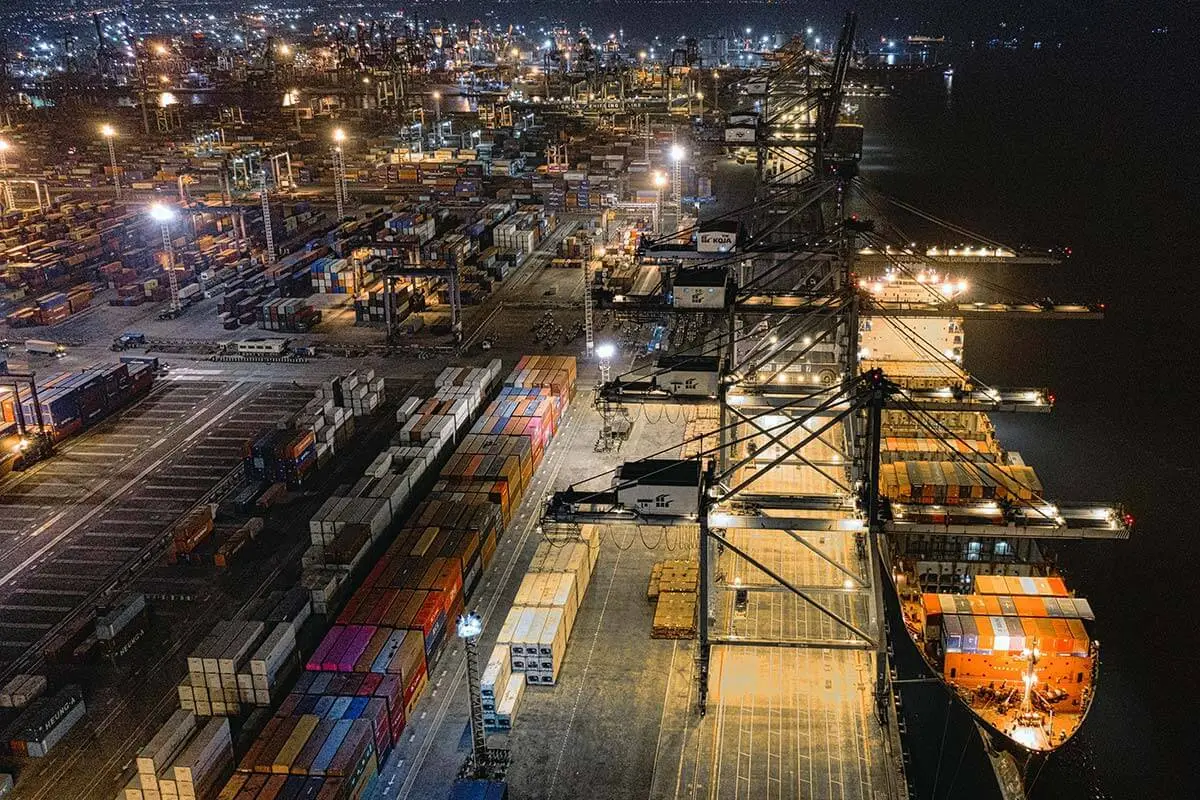

What are the different types of ports and what are their port codes? Check out our top 20 list.
Seaport codes came into effect in 1981 to facilitate global trade and logistics.
It was then that the United Nations Economic Commission for Europe (UNECE), along with major trade and transport organizations around the world, created the Code for Trade and Transport Locations – LOCODE, to standardize location identification worldwide.
Today, the UN LOCODE database includes more than 103,030 trade locations/facilities in 249 countries, including seaports, terminals, and border points.
These port codes are easy to understand by shippers, freight forwarders, customs, and any other parties involved in international shipping. They’re used on all formal paperwork – like bills of lading (BOLs), sea waybills, export/import customs declarations, etc.
In this article, we explain how international port codes work, outline the different types of ports in global trade, and share a list of the world’s top 20 busiest ports with their official codes.
Quick Overview – Types of Ports and Port Codes
How Port Codes Work
- Port codes, or UN/LOCODEs, are five-character identifiers used on bills of lading, customs declarations, and shipping paperwork. The first two characters indicate the ISO country code, and the last three specify the port (for example, CNSGH = Shanghai, China)
Different Types of Ports
- Global trade relies on many types of ports, including seaports and cargo ports, plus specialized terminals such as container ports, bulk ports, break bulk ports, and RoRo ports.
- Other important categories include ports of call, dry ports that extend seaport capacity inland, and inland ports on rivers, canals, or lakes.
Why Ports Matter for Global Trade
- With over 80% of world trade transported by sea, ports are vital supply chain hubs.
- The busiest ports by container throughput include Shanghai, Singapore, Ningbo-Zhoushan, Shenzhen, and Busan, each handling tens of millions of TEUs annually.
How Ship4wd Supports SMB Shippers
- Ship4wd connects SMBs with global trade routes by shipping from ports around the world to the largest ports across the U.S. and Canada.
- Our digital platform provides real-time freight quotes, guaranteed allocation, transparent pricing, and 24/7 human support.
International Port Codes Explained
Every port code has a 5-character format: the first 2 digits denote the country and the last 3 the port name.
Country: The first part of all UN/LOCODEs are ISO country codes, as set by the International Organization of Standardization. For instance, Canada is CA, China is CH, and Thailand is TH.
Port identifiers: The second part of the UN/LOCODES is comprised of 3 characters that denote the location, in our case, the port or terminal located within a given country.
For example, the Vancouver container terminal code is CA VAN, the Shanghai port code is CN SGH, and the Laem Chabang container port in the Gulf of Thailand is TH LCH.
In big countries like the U.S., where all possible 3-character combinations are exceeded, a number replaces the last character. For instance, the small-sized City Island Port in New York state is denoted as: US IS3
How the UN/LOCODE System Actually Works
A UN/LOCODE isn’t random. It’s a five-character code, two letters for the country followed by three letters or numbers for the specific location, maintained by the United Nations Economic Commission for Europe.
USLAX is Los Angeles, United States. CNSHA is Shanghai, China. DEHAM is Hamburg, Germany. The system covers seaports, but also airports, rail terminals, and inland border crossings, which is why you’ll sometimes see a UN/LOCODE for a location that isn’t on the coast at all. Getting the code right matters because it’s what feeds into your bill of lading, your booking confirmation, and your customs filings. A wrong port code on a booking can route your cargo through the wrong terminal entirely, especially in cities with multiple port facilities.
Common Port Codes Importers Ask About
A few codes come up often enough to be worth knowing without looking them up every time: USLAX and USLGB for Los Angeles and Long Beach, USNYC for New York, CNSHA for Shanghai, CNSZX for Shenzhen, KRPUS for Busan, and NLRTM for Rotterdam.
If you’re not sure whether a code refers to a specific terminal or the broader port area, that’s exactly what the lookup tool above is for, since some ports have a single UN/LOCODE covering multiple terminals while others assign distinct codes to different facilities within the same city. When in doubt on a booking, confirm the code with your freight forwarder rather than guessing from a code you remember from a previous shipment on a different route.
What Are The Different Types Of Ports?
With +80% of the world’s trade transported by sea, shipping ports are the backbone of the supply chain.
More than docking, international shipping ports encompass a broad spectrum of activities for cargo handling, customs clearance, and logistics.
In logistics, a seaport is more than a berthing area for loading/unloading cargo.
A port is a node where ocean and inland transport systems interact, and a place of convergence for different transportation modes.
Since maritime and inland transportation modes have different capacities, the port assumes the role of a point of load break where cargo is stored, consolidated, or deconsolidated.
Theo Notteboom, Athanasios Pallis & Jean-Paul Rodrigue (2022) Port Economics, Management and Policy
From a supply chain perspective, ports have geographical diversity in terms of the sites used for port activities, ranging from ocean ports to offshore locations.
With that in mind, here are the major types of commercial ports:
Seaport
This general term describes ports located on a sea or ocean shore.
Cargo Port
Ports servicing the supply chain are often called cargo ports, but they can also be referred to with other names depending on their specific functions. However, within the industry, a seaport means a cargo port.
Warm Water Ports
Most cargo ports are warm-water ports. This means that they are ice-free year-round, even in areas where the water is cold, like New York or Vancouver. In contrast, Russia’s hundreds of ports along the Arctic Ocean are mostly cold water ports.
No matter the temperatures, a single cargo port can have different terminals for different types of cargo that are also called ‘ports’ – depending on the context.
For instance, Haugensund Port in Norway has different terminals for dry bulk, break bulk, containers, and RoRo cargo, and it’s the leading break bulk port in Norway.
In this sense, sea and ocean ports can have specialized terminals, like:
- Container Ports, for containerized freight.
- Dry Bulk Ports, for non-liquid bulk commodities like grains, minerals, and biomass.
- Liquid Bulk Ports, for non-containerized liquids and liquefied gases.
- Break Bulk Ports, for heavy, oversized cargo like construction equipment.
- RoRo Ports, with specialized terminals for wheeled cargo loading/unloading.
Oftentimes, any type of bulk (i.e., non-containerized) cargo terminal is simply called bulk terminal, bulk port, or bulk cargo port.
Port Of Call
In the international supply chain, a port of call is a specific port where a vessel makes an intermediary stop during its voyage to load/unload cargo or perform necessary activities like refueling and repairs.
Dry Port
Dry ports are transshipment centers that operate as “an extension of a port set up inland” where the port ships its containers either through rail or road (or even barge) for distribution and customs.
To alleviate capacity and traffic pressure from the seaports, sealed containers or other types of cargo are transported directly to the dry port facility, where they are processed as if they just came off the ship.
Dry ports are connected directly with the port terminal via a high-capacity corridor and are usually located away from the sea or other inland waterway systems – hence the term dry.
Because they are set inland, they’re also often referred to as inland ports.
However, the term inland port is also used to describe freshwater harbors.
Inland Port
An inland port is located at an inland waterway, like a river, lake, or canal, which may or may not be connected to the sea.
The term inland port can also refer to a dry port, inland terminal, or other type of inland logistics center, with or without barge service.
Port Code List – Top 20
Here’s the international seaport codes list finder for the world’s busiest ports, with the highest throughput measured in TEUs. (TEU, Twenty-foot Equivalent Unit, is a standard unit of measuring cargo. 1 TEU equals the space taken by a standard 20 ft container.)
| Port Code | Location | Throughout In Million TEUs | |
| 1 | CNSGH | Shanghai, China | 49.16 |
| 2 | SGSIN | Singapore | 39.01 |
| 3 | CNNBO / CNZOS | Ningbo / Zhoushan, China | 35.05 |
| 4 | CNSZP | Shenzhen, China | 29.88 |
| 5 | CNQIN | Qingdao, China | 28.75 |
| 6 | KRPUS | Busan, Republic Of Korea (South Korea) | 23.04 |
| 7 | CNTXG | Tianjin Xingang, China | 22.19 |
| 8 | USLAX/USLCH | Los Angeles/Long Beach Port, USA | 16.65 |
| 9 | AEDXB | Dubai, United Arab Emirates | 14.47 |
| 10 | HKHKG | Hong Kong | 14.35 |
| 11 | MYPKG | Kelang, Malaysia | 14.06 |
| 12 | NLRTM | Rotterdam, The Netherlands | 13.45 |
| 13 | CNXMG | Xiamen, China | 12.55 |
| 14 | BEANR | Antwerp-Bruges, Belgium | 12.51 |
| 15 | MYTPP | Tanjung Pelepas, Malaysia | 10.48 |
| 16 | THLCH | Laem Chabang, Thailand | 8.87 |
| 17 | MAPTM | Tangier, Morocco | 8.61 |
| 18 | TWKHH | Kaohsiung, Taiwan | 8.83 |
| 19 | USNYC | New York/New Jersey, USA | 7.81 |
| 20 | DEHAM | Hamburg, Germany | 7.7 |
Source: The largest container ports worldwide in 2023, based on throughput – Statista
Where’s Your Next Shipment Headed?
Find the best quotes for your international shipments at Ship4wd’s freight-forwarding platform. Whether Port-to-Port or Door-to-Door, at Ship4wd, you can quote and book shipments in minutes and enjoy tailored shipping solutions.
Plus, our lock-in price and space up to 45 days in advance features help you plan your supply chain better and easier. At Ship4wd, we simplify logistics for SMBs. Sign up and get started today.