



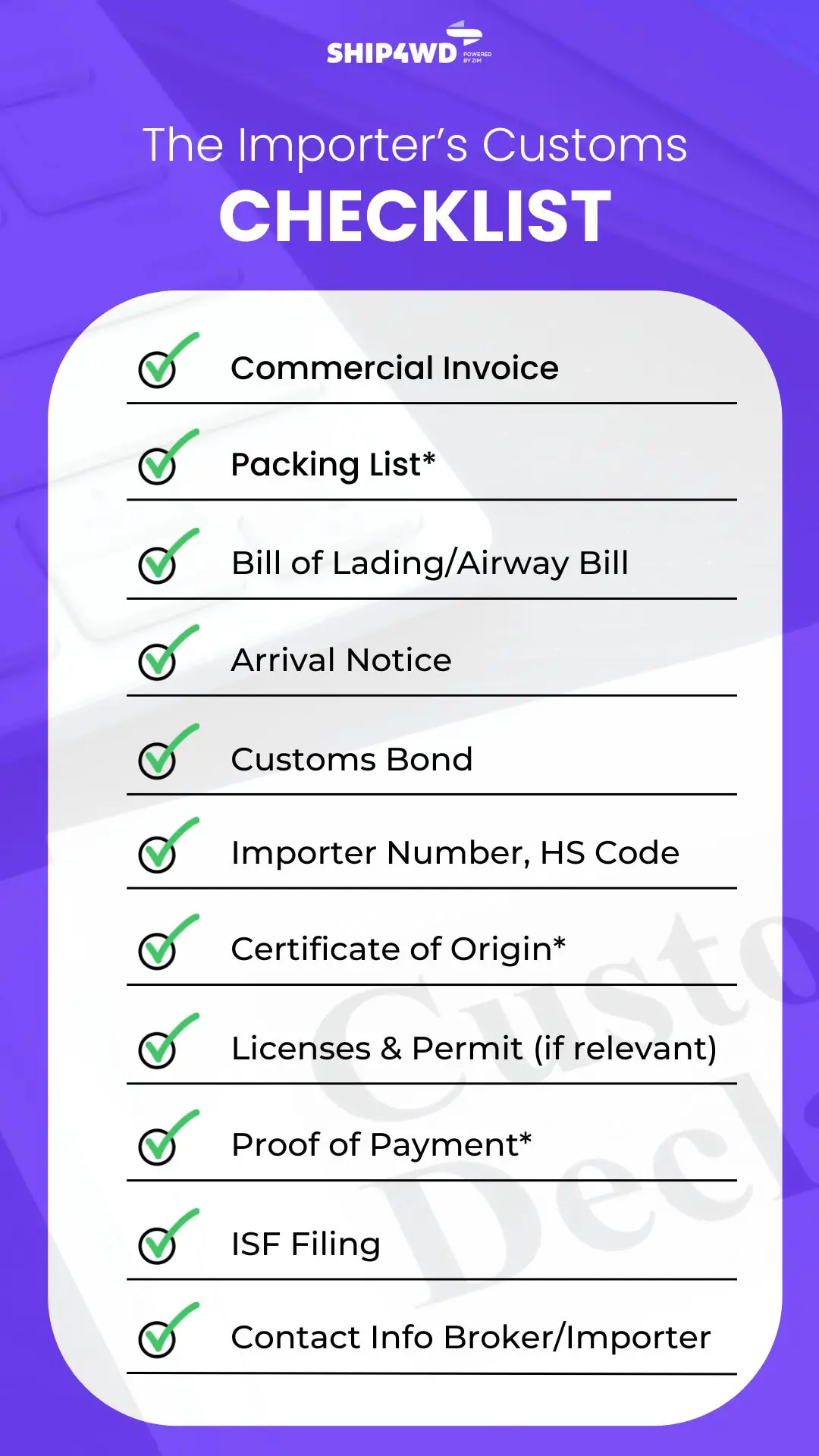
Full customs checklist available for download at the end of the post.
When importing goods into the U.S. or Canada, customs clearance can feel like navigating a maze. But with the right “backpack” of documents and details, you can clear customs faster, cheaper, and with far fewer surprises.
We sat down with Adam Lewis, Founder and President of Clearit, a digital-first customs brokerage, to build a detailed and practical checklist of everything SMB importers should have ready before their shipment arrives.
Whether you’re a seasoned business or importing for the first time, here’s what your customs backpack should include:
Commercial Invoice
Think of this as your shipment’s resume, it tells customs exactly what you’re shipping and who’s involved in the transaction. A detailed commercial invoice is a non-negotiable requirement for clearing customs. It must include:
- Seller and buyer names
- Accurate item descriptions
- HTS codes (if known)
- Country of origin
- Terms of sale (e.g., FOB, CIF)
- Currency of the sale
Without a clear invoice, customs agents may delay your shipment or assess incorrect duties.
Packing List
While not formally required, a packing list helps streamline the clearance process by providing a snapshot of the physical makeup of your shipment. It should include:
- Quantities of each item
- Weight (per item and total)
- Dimensions
- Type of packaging used
This document supports your commercial invoice and can help verify your cargo during inspections.
Bill of Lading or Airway Bill
This is your proof of shipment. The Bill of Lading (BOL) for ocean freight shipments or Airway Bill (AWB) for air freight shipments validates who owns the goods and how they’re being transported. This document links your logistics provider, forwarder, and customs broker, and is essential for tracking and releasing your cargo.
Arrival Notice
Issued by your freight forwarder or carrier once your goods have landed at the port, the arrival notice lets you and your broker know your cargo’s exact location. Without this, your broker can’t begin clearance, so make sure it’s shared promptly.
Customs Bond
A customs bond is a legal guarantee that duties and taxes will be paid.
- In the U.S., it’s required for formal entries (shipments over $2,500 USD).
- In Canada, as of May 2025, it’s required for goods valued over ~$40 CAD.
If you don’t have a bond in place, your shipment won’t move forward.
Importer Number
This number identifies you as a legal importer.
- In the U.S., it’s often tied to your EIN or SSN and must be set up through your broker.
- In Canada, importers must register through the CARM portal (Canada Border Services Agency platform).
Delays in setting this up can halt customs entry, so take care of it early.
HTS/Tariff Codes
The Harmonized Tariff Schedule (HTS) code determines how much duty you’ll pay—and whether your product qualifies for exemptions or trade agreements. Assigning the wrong code can mean overpaying, or worse, underpaying and getting fined.
Tip: If you’re not 100% sure of your code, consult a customs broker or trade advisor, though ultimately you are responsible for knowing the materials your goods are made from and what duties and licenses you need to import them to their destination.
Certificate of Origin / Free Trade Agreement Forms
These documents verify where your product was made. In an era of tariff changes and geopolitical scrutiny, a Certificate of Origin can help you:
- Avoid unexpected duties
- Qualify for trade agreements like USMCA (formerly NAFTA)
- Prove compliance during customs inspections
Licenses, Permits & PGA/OGD Certificates
Certain goods, like food, cosmetics, supplements, or medical devices, are regulated by additional government agencies.
- In the U.S., these are PGA (Partner Government Agencies).
- In Canada, they’re known as OGD (Other Government Departments).
Permits must often be obtained before the goods leave the port of origin, or they risk being rejected at the border.
Proof of Payment
Not always required, but sometimes customs will ask for it to verify declared value. This could be:
- A wire transfer receipt
- Bank confirmation
- Credit card statement
It’s a simple document that can save time in the event of an audit or review.
Import Security Filing (ISF) (U.S. Only)
If you’re shipping by ocean into the U.S., ISF must be filed 24–48 hours before your ship leaves the origin port. Failing to do this can result in, $5,000 to even $10,000 fines, and your shipment be put on hold or significantly delayed.
Your freight forwarder or broker can file it, but you are liable as the importer. Stay on top of this.
Broker Contact Info
It may sound simple, but this one gets overlooked more often than you’d think. Ensure your customs broker is:
- Listed as the “Notified Party” on the Bill of Lading
- Shared with your freight forwarder
- Available for last-minute updates or emergencies
Smooth communication between your broker, forwarder, and warehouse is key to avoiding costly delays.
Pro Tip: Prep Everything Before Clearance Starts
Don’t wait until your shipment arrives to scramble for documents. Having everything prepped and submitted helps your broker file quickly, reduces errors, and gives you more time to address any surprises.
You can download this checklist below:
Need expert help with your next shipment? Ship4wd works with trusted digital customs brokers like Clearit to make importing stress-free, fully digital, and transparent—so you can focus on growing your business. Add customs clearance to your next booking for a complete end-to-end shipping experience. Get started today!