

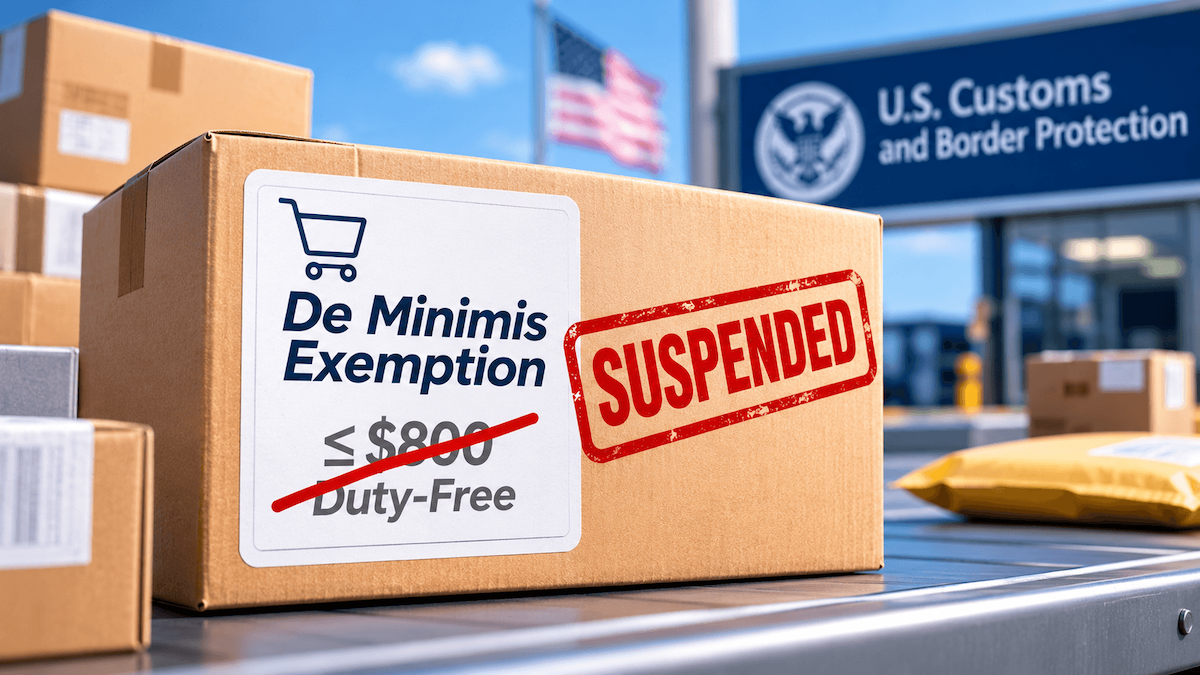

The US de minimis exemption, which let business parcels worth $800 or less enter duty-free, is suspended for goods from every country and through every shipping mode, international mail included. Commercial parcels are now subject to normal customs procedures and applicable duties and fees. What changed Until 2025, you could bring in goods worth up […]
The US de minimis exemption, which let business parcels worth $800 or less enter duty-free, is suspended for goods from every country and through every shipping mode, international mail included. Commercial parcels are now subject to normal customs procedures and applicable duties and fees.
What changed
Until 2025, you could bring in goods worth up to $800 per person per day without paying duty and with almost no paperwork. Plenty of online sellers built their restock model around it: order small, ship by courier or mail, and skip formal customs.
Goods from China and Hong Kong lost the exemption in May 2025, and every other country followed on August 29, 2025. U.S. Customs and Border Protection (CBP) has since made the suspension indefinite in its own regulations. The Supreme Court’s February 2026 ruling on emergency tariffs did not bring it back, and the One Big Beautiful Bill Act repeals the commercial exemption from July 1, 2027.
How the change affects your imports
Every commercial shipment now needs to clear customs, whatever its value or where it was made. Your border bill on a shipment has three parts: duty at the product’s tariff rate, CBP fees, and the carrier’s or broker’s own clearance charges. The CBP fees depend on the shipment’s value, the shipping mode and the type of entry filed, and carriers and brokers set their own charges, which vary by provider, service level and shipment.
For the same goods at the same tariff rate, duty follows the value, so it comes to about the same whether you ship one carton or ten. Fees and clearance charges work differently. On a low-value parcel they can add up to more than the duty itself, and if each parcel is cleared separately, you can pay them again on every one. Our breakdown of what goes into a customs clearance bill lists the usual line items.
The change lands hardest on sellers whose model depended on frequent small shipments. Marketplace sellers restocking by courier, brands shipping orders straight from overseas suppliers and anyone testing products in small batches now pay border costs they may not have budgeted for. If you already brought goods in by the pallet or the container, your shipments were above $800 and needed an entry anyway, so your process has changed less.
Cash flow shifts too. Duty and fees now have to be paid before or around delivery, on top of what you paid the supplier, so more money sits in goods you haven’t sold yet. And if you set your retail prices when parcels came in duty-free, your margin may already be thinner than your spreadsheet shows.
Four assumptions that lead to surprise duty bills
Sellers who know about the suspension still get caught out, usually by one of these.
“The Supreme Court ruling brought it back”
The February 2026 ruling struck down tariffs imposed under emergency economic powers and left the de minimis suspension in place. If you paid those tariffs on past imports, ask your broker whether you can claim a refund. A refund on old duties doesn’t reopen duty-free entry for new shipments.
“It only applies to goods from China”
China and Hong Kong lost the exemption first, so some sellers still treat the change as a China problem. Since August 29, 2025, a $60 parcel from Vietnam, India or Portugal goes through customs and pays any duty owed, the same as one from Shenzhen.
“Mail is the loophole”
International mail lost the exemption along with every other mode. Postal shipments need a customs entry and pay duty, so moving your parcels from a courier to the postal service doesn’t bring back duty-free entry.
“Splitting orders keeps each parcel under the limit”
With no exemption, there’s no limit to stay under. Ten $80 parcels owe about the same duty as one $800 shipment, and if each one is cleared on its own, the fees and clearance charges can apply ten times over. Splitting an order no longer saves duty and can add to your costs.
What to do next
Re-price your SKUs on full landed cost
Add duty, fees, freight and insurance to the product cost of each SKU, then compare the total with your selling price. Our step-by-step landed cost walkthrough shows the method. A SKU that made money under de minimis may need a price change or a different shipping pattern.
Ship fewer, larger restocks
Grouping orders by supplier and by week or month can mean fewer shipments to clear, and fewer sets of fees and clearance charges. The saving isn’t automatic. How many entries a consolidated shipment needs depends on how the goods are documented, who the importer is and whether the cargo comes from several suppliers. A larger shipment can also move from an informal to a formal entry, which carries a higher minimum CBP fee and requires a customs bond. Ask your broker to price both options before you change your pattern.
The other trade-off is cash and storage space, since bigger, less frequent shipments tie up more of both. Use the comparison below as a starting point. Transit times and costs vary by route, carrier, season and market conditions, so check them against current quotes.
| Factor | Courier parcels | Consolidated air | LCL ocean | FCL ocean |
| Customs clearance | Each parcel cleared separately | Depends on documentation | Depends on documentation | Depends on documentation |
| Speed | Often quickest for small loads | Generally faster than ocean | Can take longer than FCL | Slower than air |
| Freight cost per unit | Often highest | Can beat courier on larger loads | Suits loads below a container | Can be lowest at full volume |
| Good fit for | Samples, urgent orders | Urgent or high-value restocks | Regular smaller restocks | High-volume, steady SKUs |
Courier parcels still make sense for samples and urgent one-off orders, where speed matters more than cost per unit. Once you’re sending several cartons a week from the same supplier, pooling them into one air shipment can cut the freight and clearance cost per unit, depending on how the shipment is entered. Airlines price on chargeable weight, the greater of actual and volumetric weight, so work out the chargeable weight of your cartons before you compare quotes.
For predictable restocks, ocean freight can bring the lowest freight cost per unit in exchange for longer transit. If your volume falls short of a container, less-than-container load (LCL) lets you pay for the space you use, and goods for a single importer can often clear together. On Ship4wd you can book shared-container ocean freight online and see the full freight quote before you commit.
Decide who handles customs and duty
Under delivered duty paid (DDP) terms, the seller is responsible for import clearance and pays the duty and import charges, often through its forwarder or broker, and delivers to your named destination. Under delivered at place (DAP) terms, the seller pays to get the goods to your named destination, and you or your broker handle import clearance and pay the duty. DDP can give you a more predictable delivered price, and DAP gives you more control over the entry and its data. If you choose DDP, ask who acts as importer of record, since that party is legally responsible for the entry, and confirm the price covers every tariff and fee that applies to your goods.
Whichever terms you use, compare quotes on the same basis. Check whether each one includes duty, fees and final delivery, so you aren’t weighing a full landed price against a partial one.
Get your product details right
Keep one record per SKU with its tariff code, country of origin and customs value, and share it with your supplier so the commercial invoices match. Now that every parcel files an entry, a wrong code can mean the wrong duty rate or a held shipment. If a shipment does get held, our guide covers what to do when goods get stuck at customs.
Ask your broker or carrier the right questions
Before your next restock, ask which tariffs apply to your products and how their fees change as your shipments get larger. Ask whether they need a customs bond from you and how they bill duty. If you sell food, supplements or other regulated goods, ask who files with agencies like the FDA, because low value doesn’t exempt goods from those rules either.
How much can I import to the USA without paying duty?
For business imports, no dollar threshold remains. Even a $5 commercial shipment is subject to customs requirements and any applicable duties and fees. . Goods with a zero duty rate still need an entry, and other tariffs or fees can apply to them.
Will the de minimis exemption come back?
Not under current law. CBP’s regulations suspend the exemption indefinitely, and the One Big Beautiful Bill Act repeals the commercial exemption from July 1, 2027, so restoring it would take new legislation. Plan your import model on the assumption that it stays gone.
Moving restocks from parcels to freight with Ship4wd
Ship4wd doesn’t clear individual postal or express parcels. If you ship one parcel at a time, your carrier or its broker clears each one. Ship4wd helps with the switch many sellers end up making: moving regular restocks into consolidated air or ocean shipments.
When you book air freight, LCL or full container load (FCL) to the US on the platform, you can add a customs clearance team that files the entry for you. For China-to-US air and LCL shipments up to 68 kg, a door-to-door booking with duties priced in gives you one all-in price before you book. Consolidated freight fits best when you restock the same SKUs from the same suppliers on a regular cycle.
See how Ship4wd works and get a rate quote for your next restock.
Related articles
US import tariffs: what applies to your shipments