

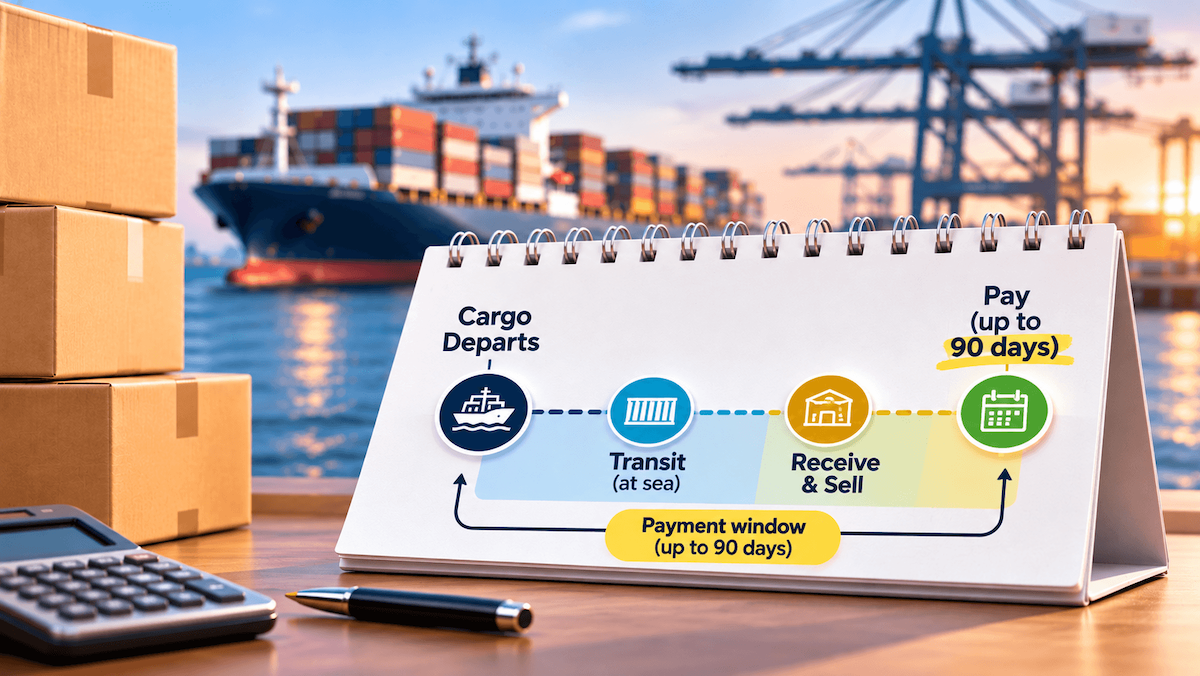

Paying after your cargo departs moves the date you pay for a shipment without changing what you owe. With Ship4wd, you can pay up to 90 days after your cargo departs, subject to eligibility, so part of that window covers the weeks your goods spend at sea and part covers the time you spend selling […]
Paying after your cargo departs moves the date you pay for a shipment without changing what you owe. With Ship4wd, you can pay up to 90 days after your cargo departs, subject to eligibility, so part of that window covers the weeks your goods spend at sea and part covers the time you spend selling them.
The detail that matters most is the start date. Departure-based terms count from the day the cargo leaves, and that one fact decides how much breathing room you get once the container lands.
Why payment timing matters right now
Ocean freight costs more than it did in the spring. Spot rates move every week, so check the current figure before you build a cash plan around it.
You also pay duties at entry, and the legal basis for US tariffs shifted more than once in 2026, which makes landed cost harder to pin down months ahead. Our guide to how current US import tariffs stack up covers the duty side in detail.
Where your cash sits between the factory and the sale
You pay out in stages, and each payment can land weeks before any revenue comes back. The supplier gets paid on whatever deposit and balance terms you agreed. Freight follows, then duties and entry fees once the goods reach customs, then inland delivery to your warehouse or fulfillment center. Your own customers pay you after all of that, and if you sell on terms or wait on a marketplace payout, the gap stretches further.
Transit adds its own block of time. Standard ocean transit from Asia runs 20 to 45 days depending on route, and that figure covers the voyage alone. Add production lead time and the selling period, and the stretch between your first payment and your first sale can run for months. Then come the charges that tend to show up after the quote, such as demurrage when a container sits at the port past its free days.
How a pay-after-departure term works
The payment clock starts on the day your cargo departs. Arrival and delivery dates have no effect on it, so the time your goods spend in transit comes out of the window you have to pay.
Take an illustrative shipment. A 40-foot container leaves Shanghai on March 1, and your terms give you the full 90 days, so payment falls due on May 30. If the voyage takes 30 days, the goods land around March 31, which leaves you about two months after arrival to clear customs, deliver and start selling. A longer route, port congestion or a customs hold eats into those two months, so plan from the departure date on your booking and treat the post-arrival stretch as the variable.
To use Ship4wd’s departure-based payment terms, payment terms are subject to eligibility and approval, and that credit limits may vary.
What payment terms change, and what they don’t
Terms change the date you pay. Your freight rate, the duty on the entry and your landed cost all stay where they were.
If a product’s margin no longer works at today’s freight and duty levels, paying later won’t repair it. Rework your landed cost at current rates first, then use terms to manage the timing gap. Plan for customs duties on their own schedule unless your terms state that duties are covered.
How payment timing options compare
You probably use one or two of these already. The start date and the gate are what separate them.
| Option | When the clock starts | What to check |
|---|---|---|
| Supplier payment terms | Set in your contract with the supplier | Terms can be harder to win from a new supplier |
| Card payment | Your card’s billing cycle | The limit is shared with other spend, and processing fees may apply |
| Payment terms from your forwarder | Set by the provider (on Ship4wd, departure) | Eligibility, and which charges the terms cover |
| Trade finance from a lender or bank | Set by the lender | Revenue, time in business or collateral requirements can rule out smaller importers |
Who gets the most from departure-based terms
Wholesalers and distributors feel the gap hardest, because buying in volume ties up the most cash per order and margins on volume goods can be thin. Seasonal importers who order well ahead of their peak face the same problem on a calendar: the money goes out months before the busy season brings it back.
If you sell on Amazon or Walmart, running out of stock can cost you sales and search ranking. Keeping cash free means you can reorder on time instead of waiting for the last shipment to sell through.
What to check before you count on payment terms
Start with approval. Terms depend on eligibility and on the limit you’re given, so confirm both before you place an order that relies on them. Then find out exactly which charges the terms cover, and date every due date from departure in your cash plan.
Ask how a delayed or rolled sailing affects your due date before you book. Keep duties and any post-arrival charges in the plan as separate lines, and decide whether you’ll settle by card, ACH, wire or PayPal, since each one moves money on a different timeline.
Does the payment window start when my cargo arrives?
No. The window counts from the date your cargo departs, so ocean transit time comes out of it. The time left once the goods land depends on your route and on any delays at the port or in customs.
Does paying later change what I owe?
Paying later changes the due date. The freight charges and duties on the shipment stay the same, so your landed cost doesn’t move.
How Ship4wd helps you plan around payment timing
Ship4wd’s departure-based payment terms are available subject to eligibility, and you see the full quote before you book, so you know the amount you’re scheduling. You can settle shipments by card, ACH, wire or PayPal, and regular shippers can move to long-term contracts at improved rates.
See how Ship4wd works and check whether your business qualifies for payment terms.