



Master your supply chain by learning the key components of ocean freight rate charts and leveraging them to optimize your shipping costs.
Since most businesses transport their goods by ocean, understanding the freight pricing dynamics is important for optimizing shipping costs.
However, obtaining a reliable ocean freight rates chart is difficult, especially if you rely on traditional freight forwarders.
Instead, when you work with a digital freight forwarder—Ship4wd—you can leverage the digital platform and innovative logistics solutions.
We generate instant shipping quotes, which will help you compare pricing from multiple shippers in one dashboard.
Besides, we help you secure competitive shipping prices in advance to optimize your budget. Our pricing is transparent, without any hidden costs that force you to dig deeper into your pockets.
Take complete control of your ocean freight costs today—register for a free Ship4wd account now.
Why Freight Rate Charts Matter for Supply Chain Strategy
Here’s why freight rate charts are critical for solid supply chain strategies:
- Proper Budgeting and Cost Management: You can rely on current rate trends and historical freight rates you see on charts to budget more accurately and minimize the risk of unforeseen expenses.
- Identifying Cost-Effective Shipping Routes: You can analyze charts to see which shipping lanes or routes are easier and cheaper and if they align with your delivery timelines.
- Competitive Advantage: Optimizing freight expenditure and shipping efficiency can help you pass some of the benefits or savings on to your customers. Better product pricing and customer support can improve your competitiveness in the industry.
- Planning for Unforeseen Disruptions: Using high-level rate charts can help you anticipate fluctuations in rates due to natural disasters, capacity shortages, or changes in fuel prices. This foresight allows you to plan better, so you can book shipments earlier or adjust your strategy to avoid or reduce the effect of disruptions.
- Better Inventory Management: Once you understand current freight rates, you can enhance your shipping frequency to optimize stock levels. For example, you can order in bulk or consolidate shipments if you expect shipping costs to rise shortly.

Key Factors Affecting Ocean Freight Rates
You can expect ocean freight prices to vary significantly between shipments or regions, depending on factors such as:
- Bunker Fuel Cost Fluctuations: An increase in bunker fuel costs directly increases ocean freight shipping rates.
- Interplay Between Demand and Supply: Peak seasons see a surge in shipping demand, and the resulting capacity shortages lead to higher rates. Conversely, overcapacity and low-demand periods result in lower rates as carriers seek to fill their containers.
- Shipping Route and Distance: Some shipping routes and lanes can be costlier due to heavy traffic or higher risks. You can also expect higher ocean freight costs as the distance between the origin and destination ports increases.
- Weather Conditions: Adverse conditions like fog, storms, and hurricanes can delay shipments, affect shipment schedules, and increase operational costs. Carriers are likely to increase their prices to cushion themselves against the negative impacts of possible disruptions.
- Type and Amount of Cargo: Dangerous or specialized cargo typically attracts higher rates. The weight and volume of cargo also affect shipping costs because base freight rates are calculated using actual gross weight or the volumetric weight of your cargo.

Components of a Freight Rates Chart Explained
Freight charts usually consist of a table with columns and rows showing various components, their descriptions, and the corresponding rates. The chart typically includes the total shipping cost.
You can expect the following elements from a historical or current ocean freight rates chart:
- Base Freight Rate: This is the basic cost of shipping cargo from the port of origin to the destination port. The cost is usually indicated per container.
- Additional Charges: These are usually broken down into separate rows for each cost. They may differ by shipment, including fuel surcharge, container freight station charges, handling fees, and terminal handling fees. Other charges include peak season surcharge, customs clearance fees, and currency adjustment factors.
- Additional Service Charges: Depending on the ocean freight forwarding company and your preference, the total shipping cost may include extra service charges. These include customs clearance fees (if delegated to the forwarder), inland haulage charges, pre-shipment inspection costs, cargo insurance costs, and door-to-door delivery costs.
- Shipment Details: The freight rates chart can include shipment information such as the ports of origin and destination because they matter in several ways when determining shipping costs.
- Type of Ocean Shipping: The chart can show whether you are using full container load (FCL) shipping services or less-than-container load (LCL) freight services.
- Carrier: Most freight rate charts usually include the name of the carrier.
- Shipping Route: Freight rate charts usually include the shipping route since it’s one of the factors affecting ocean freight costs.
Since freight charts differ significantly by shipment and service provider, you should promptly talk to your freight forwarder. They might be willing to provide a custom freight rates chart or quotation.

Major Ocean Freight Rate Indices to Monitor
Studying ocean freight rate charts alone may not be enough in the long run. For a fuller picture of current and historical ocean shipping costs, you might want to consider freight indices.
Below are the most significant ocean freight rate indices to monitor:
- World Container Index (WCI): The WCI is offered by Drewry, a frontline international maritime and shipping research and consulting services provider. The freight rate index monitors weekly container shipping rates across eight major global shipping lanes. You can use it to check changes in the shipping costs of 40-foot containers.
- The Baltic Dry Index (BDI): If you want insights into the dry bulk shipping market, the BDI is for you. This shipping cost index focuses on the price dynamics of transporting dry bulk items like grains, iron ore, and coal.
- The Shanghai Containerized Freight Index (SCFI): The SCFI shows container shipping rates for shipments leaving Shanghai, China. It’s ideal for shippers who usually trade with Asia. You can refer to it if you use sea freight from China to the US East or West Coast.
- UNCTAD Liner Shipping Index (LSI): The LSI is offered by the United Nations Conference on Trade and Development. You can use it to monitor global container transport capacity, costs, and how well countries are connected to global shipping networks. The index also shows the deployment of container ships and their availability relative to their demand.

Ocean Freight Rate Trends and Insights
When you study sea freight indices, charts, and other materials, you may note ocean freight rate trends such as:
- Alternating Fluctuations in Shipping Costs: Ocean freight costs usually rise and drop intermittently depending on various factors. For example, shipping rates surged during the coronavirus pandemic, which later died down. You can try to time your shipments when prices are lower.
- Competitiveness in Freight Costs: According to Mordor Intelligence, the ocean freight market keeps expanding due to economic liberalization and the increased efficiency of ocean freight as a mode of transport. Service providers optimize their prices to compete effectively, and you can leverage this competition to minimize costs.
- Shippers Willing to Pay Premium Rates: Research shows that shippers are inclined to pay more on significant trades to secure space for LCL shipments in Europe due to high demand in the US. If you ship goods to Europe, you may have to grapple with higher LCL shipping costs. Ensure you budget more in advance.

How to Leverage Freight Charts to Maximize Cost Savings
Researching ocean freight rate charts and indices can be futile if you don’t put your observations to work.
You have several options for leveraging freight charts to minimize shipping costs:
- Always check for volume discounts from different carriers whenever you have a shipment.
- Always compare rates and quotes from different carriers to choose the most favorable.
- Use freight audit software to see big data analytics and identify cost-saving opportunities.
- Compare different shipping lanes or routes to choose the most cost-effective depending on distance and delivery times.

Where to Find Reliable Ocean Shipping Rate Charts
If you are looking for historical charts on ocean freight rates, you may have a hard time because these are typically only available offline with traditional freight forwarders.
However, if you want dependable, modern freight rate charts, working with digital freight forwarders is better. At Ship4wd, we can help you find favorable ocean shipping rates.
You can always use our digital platform to check the cost of your shipment. Unlike general freight charts, our dashboard generates charts based on real information you provide about your shipment.
Compare Freight Rates Instantly with Ship4wd
With the Ship4wd digital freight forwarding cost calculator, you can generate and compare instant shipping quotes from multiple carriers. Simply fill in your shipping information and required services.
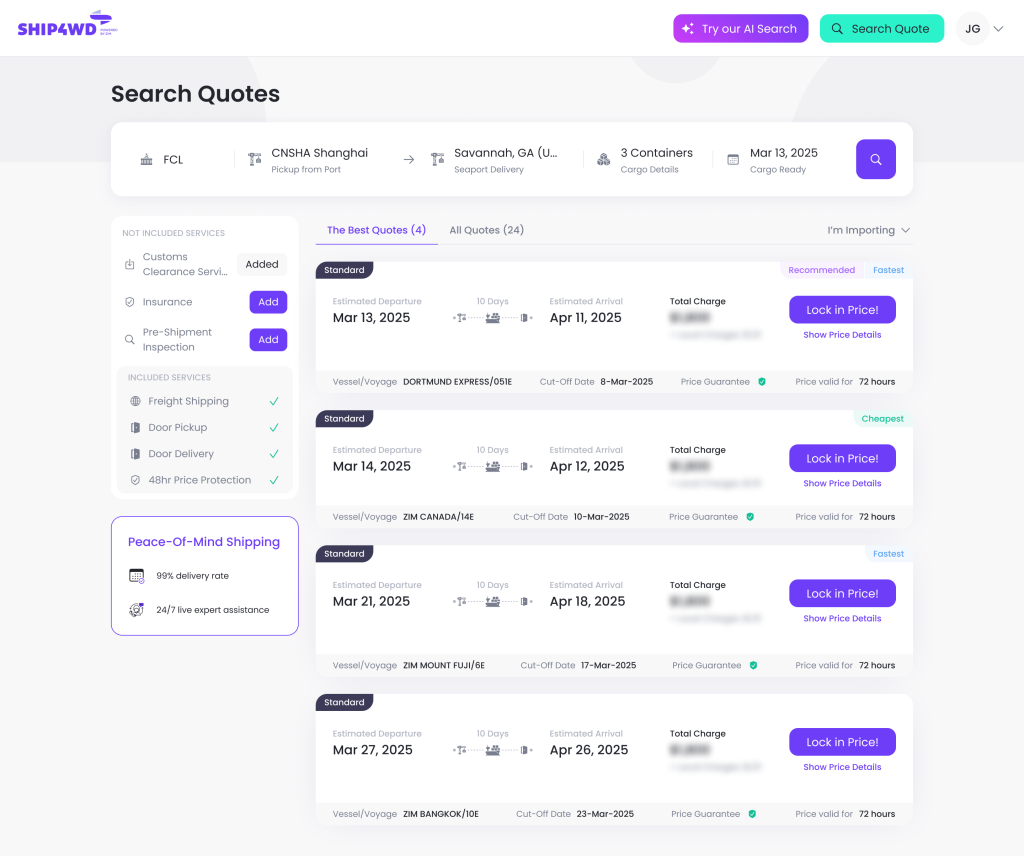
Our quotes are detailed, showing the carrier, expected departure and arrival dates, the booking deadline, the number of days the shipment will take, the total freight charges, and any applicable local charges.
You can also see how we grade various quotes, with designations like standard, basic, earliest, fastest, or cheapest shipping options.
Here’s what a typical ocean freight quote looks like using our free online freight forwarding cost calculator:
Can’t wait to get started? Search and compare shipping quotes with Ship4wd today.
Frequently Asked Questions (FAQs)
Let’s end the discussion with questions business owners usually ask about ocean freight rates:
Are Ocean Freight Rates the Same for All Shipping Companies?
No. Ocean freight rates aren’t the same for all shipping companies.
Pricing structures differ significantly from company to company. Even if companies use common carriers, they may have negotiated different shipping prices with them.
Do Ocean Freight Rate Charts Include Additional Surcharges?
Yes. Ocean freight rate charts usually include additional surcharges that may apply, such as fuel surcharges and peak season surcharges.
When you work with Ship4wd as your freight forwarder, we guarantee pricing transparency. Our freight shipping quotes do not have hidden charges.
Can I Lock in a Fixed Ocean Freight Rate?
Yes. When you use Ship4wd, you can lock in a fixed ocean freight rate. When you generate quotes, you can see a Lock in Price button and how long each price is valid.
You can also see if the price is guaranteed or only available for a limited time.
Are Ocean Freight Rates Calculators Accurate?
Ocean freight rate calculators are great for estimating prices and can be accurate if you provide all relevant data and they consider as many applicable factors as possible.
Most calculators are reasonably accurate, depending on the information you provide and the complexity of the shipment.
Conclusion
Learning how to interpret and use an ocean freight rates chart can greatly optimize shipping costs.
By comparing rates and other shipping information from different charts, you can make better short- and long-term decisions.
However, it’s not easy to obtain and compare different charts. That’s why you should use digital freight forwarding software to generate and compare instant shipping quotes from multiple carriers in real-time.
As the best digital freight forwarder, Ship4wd offers transformative solutions for freight pricing.
In addition to getting instant comparable quotes, you can lock in prices within a limited period. Our pricing is also transparent and has no hidden costs.
Join us at Ship4wd today to optimize your shipping costs.